Pool Excavation
Inground Pool Digging in Edison, NJ
Edison Excavation digs inground pools for pool companies and for homeowners managing their own build in the Edison area. The dig follows your pool company's spec sheet for dimensions, depths, and over-dig, the spoil gets a plan before the machine arrives, and the excavation is scheduled around the date the shell goes in.
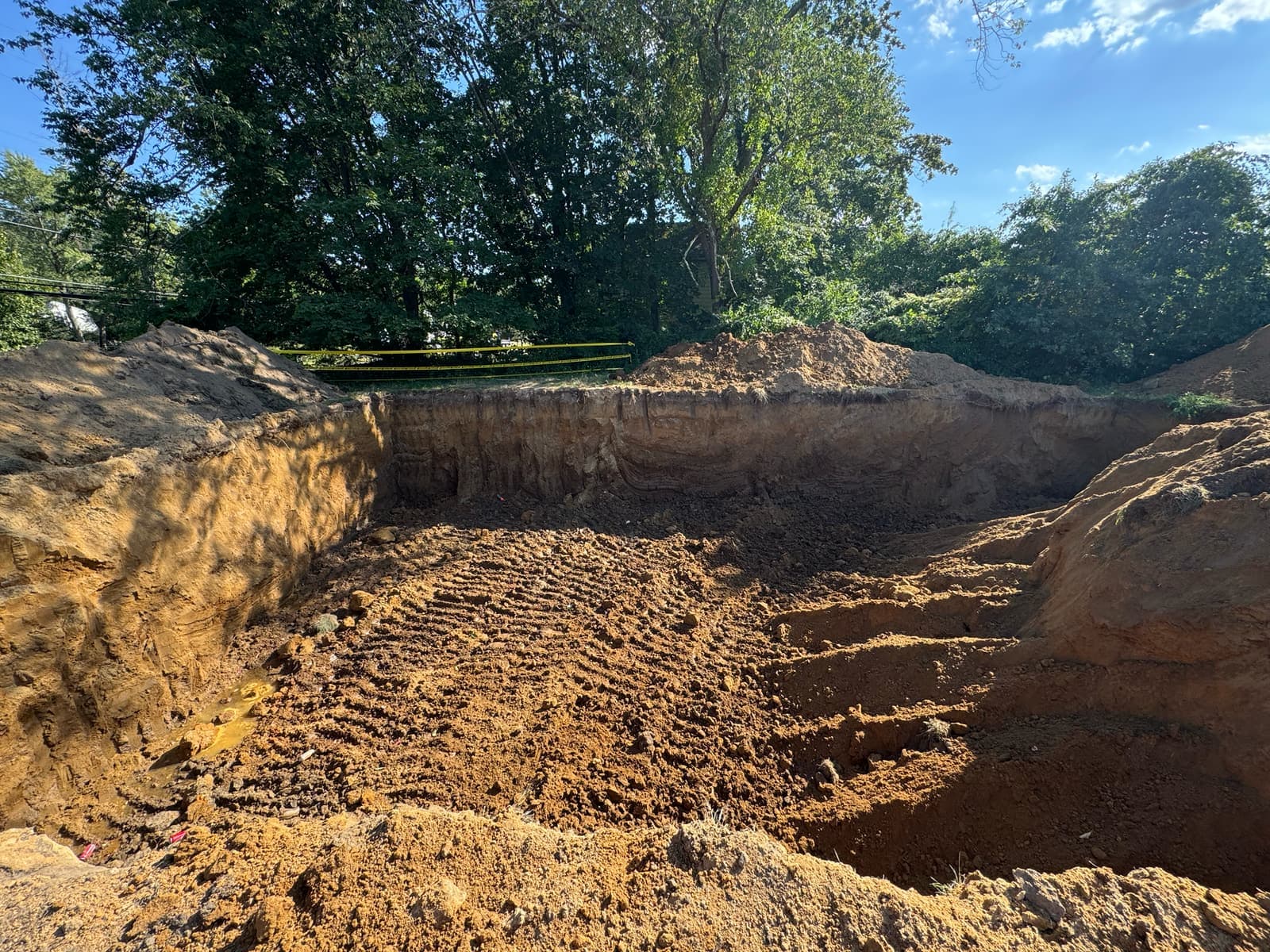
Following the dig sheet
Your pool company sets the shell. The hole goes where their sheet says, once the 811 utility markout clears the yard.
Their Sheet, Our Excavator
Each pool builder provides a dig sheet: footprint, depths, transitions, and the over-dig their crew needs around the shell. Those figures get marked out on the lawn first and checked again as the floor takes shape, so the hole matches the paper.
Spoil Planned, Not Piled
Before the dig, the plan for the soil is settled: haul-off in the 7-yard dump truck, regrading on site, or some of each. No mystery mound left on the lawn for weeks.
Side-Yard Access Planned
The path the excavator and truck will use gets walked ahead of time, fence panels come out if needed, and ground protection goes down, so the pool area is the only part of the yard that's opened up.
Most of a pool dig is the dirt
Pool digs generate more soil than most people expect. Soil takes up more room once it's out of the ground than it did in it, so even a modest pool becomes load after load. Handling that volume is the real logistics problem, which is why the haul route and truck cycle get worked out before the excavator starts. Clean, usable fill can stay for regrading if the yard needs it, and the rest is trucked out.
Where we work
Timing is the other half. An open pool hole is exposed to weather, and rain in an unprotected dig means pumping, slumped walls, and re-cutting. The dig date gets set against the pool company's shell or steel date so the hole is not left open waiting on the next crew.
Doing the dirt math before anyone digs
A pool's soil volume is plain arithmetic. Take a 16 by 32 foot pool with an average depth of 5 feet: 16 times 32 times 5 is 2,560 cubic feet, and dividing by 27 gives roughly 95 cubic yards as it sits in the ground. The over-dig your builder calls for around the walls adds to that. So does the deep end if it slopes past the average.
Then the soil swells. Dug material is looser than the packed ground it came from, so the pile and the truckloads run bigger than the in-ground figure. Divide the real total by a 7-yard dump truck and you can see why a pool dig is mostly a trucking job with an excavator attached.
Your own numbers come from your spec sheet and the site walk. The example is only there so the load count on a written price makes sense when you see it.
What a pool dig typically costs in New Jersey
As a typical New Jersey market range, not our quote: digging the hole for an inground pool usually runs $1,500 to $6,000, with most digs landing near the middle. Rock, or a backyard the machine cannot reach directly, can push the figure well past the top of that range.
Three things decide where a given yard falls: the cubic yards coming out, how the soil behaves once it is open, and where the spoil goes. Keeping clean fill on site to raise a low corner is cheaper than trucking every yard away. A site walk turns those unknowns into one written price.
Glacial leftovers in the hole
Edison sits along the Perth Amboy Moraine, the band of debris the Laurentide Ice Sheet left at its southern edge. It runs from Perth Amboy through Woodbridge, Edison, and Metuchen and crosses the Edison and South Plainfield line. Ground built by a glacier can be a jumble: layers that change from one end of a pool to the other, and the odd buried cobble or boulder.
A pool goes deeper than most residential digs, so it has more chances to find something. Nobody can promise what is under a particular yard, and a map won't tell you. If the builder or owner wants to know before signing, a test pit at the deep-end location answers the question before the full dig is scheduled.
Lines in the yard that nobody marks
Under NJ One Call's rules, the contractor hired to dig places the ticket, at least three full business days before the work and no more than 10 business days ahead, with weekends and holidays not counted. Utility companies then mark their own lines, and the electric company marks its service up to the meter.
Backyards are where the unmarked lines live. Power to a shed, landscape and lamp-post lighting, and feeds to an old pool heater or pump all belong to the property owner after the meter, and they stay unmarked unless the owner is a One Call member. If you know where any of those run, say so at the site walk. Within 2 feet either side of a marked line, digging is done by hand, and a damaged gas line means calling 911, the gas company, and 811.
Permits beyond the pool itself
The pool permit is your pool company's paperwork. The excavation can touch a few others. Edison Township's published permit flow charts call for a soil export permit when 10 cubic yards or more leaves the site, which nearly every pool dig that trucks out spoil will cross. They also call for a site improvement permit when a project adds more than 500 square feet of new impervious coverage or disturbs 1,250 square feet, with the final determination made at zoning permit review. A pool deck plus a patio adds up quickly against those lines.
Those are Edison's charts; confirm the current rules with the township. Other towns run their own process, so in Metuchen, Piscataway, Linden, or elsewhere, check with the municipality's construction or engineering office.
On a bigger backyard project, state rules can come in as well. Chapter 251 requires a certified soil erosion plan for disturbance over 5,000 square feet, through the Freehold Soil Conservation District for Middlesex County or Somerset-Union for Union County towns. New Jersey's stormwater rules (N.J.A.C. 7:8) treat a project as major development if it disturbs an acre or more, or adds a quarter acre (10,890 square feet) or more of regulated impervious surface. A single family pool rarely gets near that second line, but it is worth knowing it exists.
What happens after you call
From the site walk to the final cleanup
1. Site Walk
We visit the property by appointment, check access and any constraints, and go over your plans or what you have in mind.
2. Marking & Layout
The layout is marked on the ground from the plan. Depths, lines, and elevations are set out before any digging starts.
3. The Work
The right machine for the access comes in, ground protection goes down where needed, and disturbance to lawns, trees, and hardscape is kept to a minimum.
4. Clean Handover
You're left with a site ready for the next step and a yard that's still in one piece.
Frequently Asked Questions
Yes, that's the usual setup. They send the dig spec, the excavation follows it, and the date is coordinated with their shell delivery or steel crew. For owner-managed builds the manufacturer's dig sheet gets used the same way.
Start with length times width times average depth, in feet, and divide by 27 to get cubic yards in the ground. Add the over-dig on the spec sheet, then expect the pile to grow once the soil is loosened. At the site visit you'll hear what leaves, what can be reused on site, and how that affects the price.
Pool digs need the 5 to 6 ton excavator, so a real access path is required, usually a side yard and sometimes with a fence section removed. The route gets confirmed at the site walk and protected. Utility markout through NJ One Call always comes first.
Yes. New Jersey's construction code exempts ordinary fences 6 feet or under from permits, but that exemption does not cover barriers around swimming pools (N.J.A.C. 5:23-2.14). Your pool company or fence installer handles that permit with the construction office.
Service Areas
- Edison· Middlesex County
- Metuchen· Middlesex County
- Piscataway· Middlesex County
- Woodbridge· Middlesex County
- Highland Park· Middlesex County
- South Plainfield· Middlesex County
- Perth Amboy· Middlesex County
- Carteret· Middlesex County
- Rahway· Union County
- Linden· Union County
- Plainfield· Union County
- Dunellen· Middlesex County
Edison, Metuchen, Piscataway, Woodbridge, and nearby Middlesex and Union County towns north of the Raritan.
Got a dig sheet from your pool builder? Send it and we'll walk the site.
Site visits are by appointment. Share a few details about the project and a time gets set to walk the property together.