Clearing & Site Prep
Lot & Land Clearing in Edison, NJ
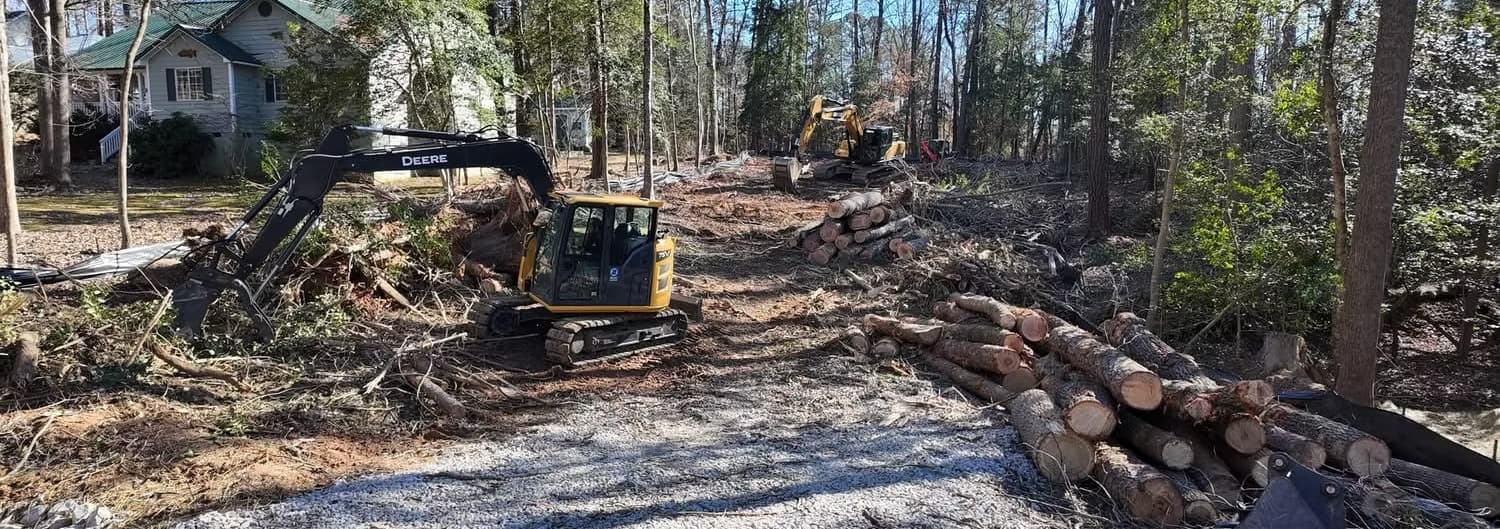
Edison Excavation clears residential lots and overgrown backyards. Brush, tangled growth, and stumps that are in the way come out, and the mature trees and features that give the property its character stay put.
Our clearing approach
Over-clearing leaves a property looking scraped for a long time. The aim is to remove what's in the way and keep what matters.
Clearing by Selection
Brush, overgrowth, and volunteer saplings come out by hand and by machine. Before any of it starts, the trees and root zones worth saving get flagged.
Stumps & Roots Pulled
An excavator lifts stumps and roots out whole, leaving firm ground ready for grading rather than a yard covered in grindings.
Debris Loaded and Hauled
Brush, logs, and root balls go into the dump truck and leave the property, since New Jersey does not allow burning them. The cleared area is raked back to a walkable grade.
Clearing for yards people already live in
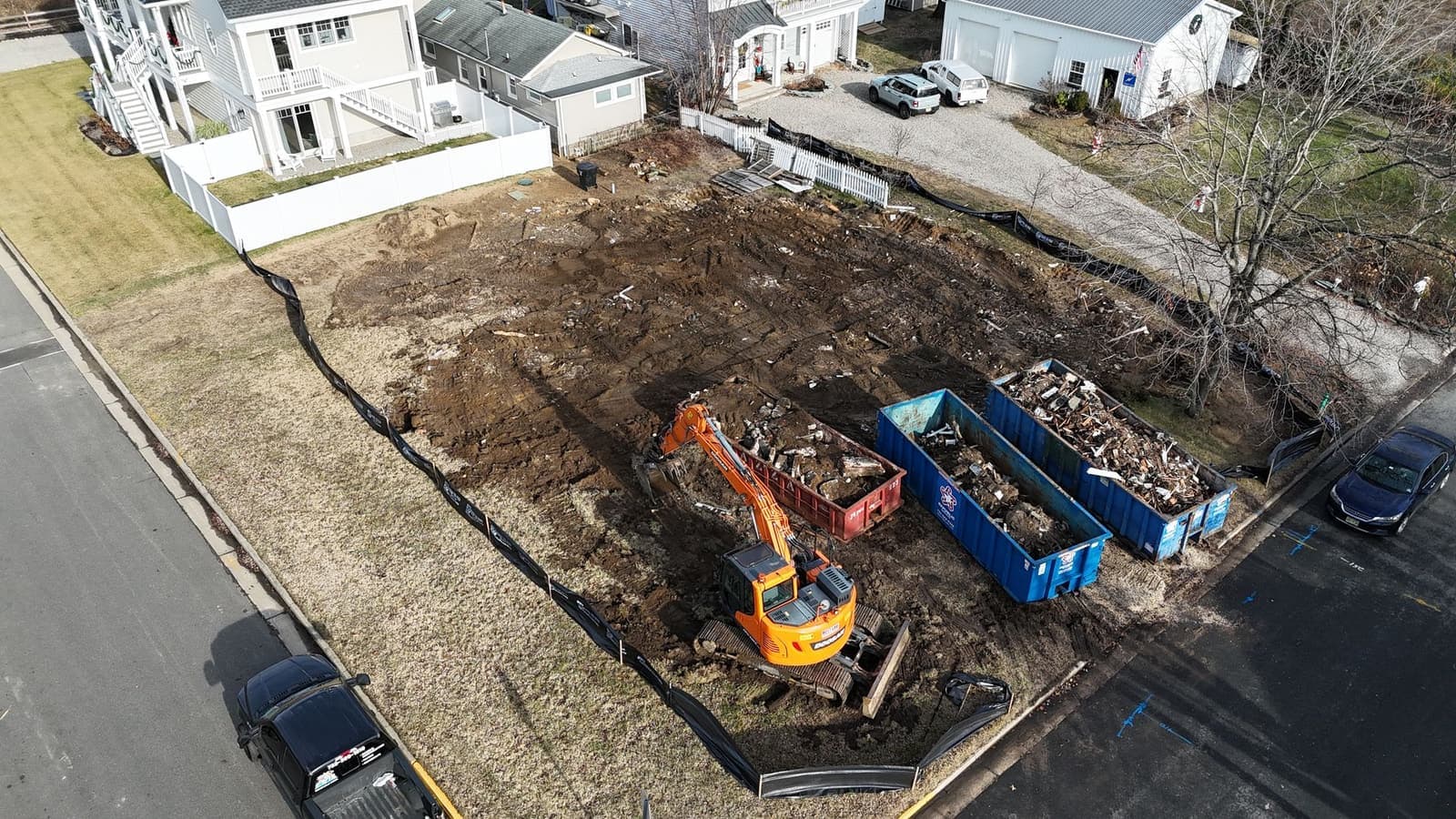
Most clearing equipment is designed for open acreage, not a fenced suburban backyard full of trees the owner wants to keep. A tracked mini skid steer and a 2.5 to 3 ton mini excavator pass through tight gates and work near the house and plantings, so what you want removed gets removed and nothing else does.
Where we work
That suits jobs like opening up a crowded backyard, reclaiming a grown-over back corner, or clearing space for something new, while the keepers stay.
What clearing usually costs here
These are typical New Jersey market ranges, not our quote. Clearing overgrown or wooded ground runs about $1,400 to $6,000 or more per acre, and a homeowner clearing only part of a lot often spends $1,500 to $6,000 all in. The spread is wide because the word covers everything from cutting back light brush to dropping mature trees and pulling every root.
Density, tree size, slope, and gate width all move the figure, but disposal moves it most. With burning off the table in New Jersey, every pile has to ride out in a truck, and the number of loads is something a site walk can count. That count is what goes into the written price.
The plants that take over a neglected corner
Overgrowth in a New Jersey backyard is rarely native. The usual mix includes multiflora rose and Japanese barberry, both thorny; Japanese honeysuckle and porcelain berry, vines that blanket fences and smother shrubs; and autumn olive, tree-of-heaven, and Norway maple, which seed in fast and shade out everything below.
Cutting them off at the ground leaves the roots behind, so wherever the ground allows it the root crowns come out with the machine too. Whatever does come up the next season is easier to pull while it's small than after it has climbed the fence again.
Spotted lanternfly and the ash trees
Tree-of-heaven is a host plant for the spotted lanternfly, which is one more reason to get it out of the yard. Middlesex County joined the New Jersey Department of Agriculture's lanternfly quarantine on August 30, 2021, and every county in the state is now under it. Businesses that move vehicles, equipment, or goods in or out of the quarantine zone need an NJDA permit, so ask whoever clears your lot how they handle it.
Emerald ash borer reached Middlesex County by October 2015 and has killed many of New Jersey's ash trees since. A standing dead ash near a house or a fence line is a common reason a clearing job starts.
Edison's tree permit flow chart
Edison Township publishes permit flow charts for common site work. For trees, the non-emergency question is whether the removal is part of a subdivision or the project needs a demolition permit from the code office. If either is true, a tree removal permit is required. If neither is, the chart says one is not.
Emergencies run differently. If a tree is dead or dying and an imminent danger, the chart asks for photographic proof or a certified letter from a licensed arborist or forester saying so; the tree can then be removed and the permit submitted at the same time. Confirm the current version with the township before you rely on it. Metuchen, Piscataway, Linden, and the other towns set their own rules, so check with that municipality.
The same charts call for a site improvement permit once work disturbs 1,250 square feet, and a soil export permit at 10 cubic yards of soil leaving the site. Stump pulling and regrading after a big clearing can reach both.
When cleared ground crosses the state lines
Clear enough ground and state law gets involved. The Soil Erosion and Sediment Control Act (Chapter 251) requires a certified erosion control plan when a project disturbs more than 5,000 square feet, roughly a 50 by 100 foot area. In Middlesex County that plan is certified by the Freehold Soil Conservation District; Union County towns such as Linden and Rahway go to the Somerset-Union district.
At one acre of disturbance, New Jersey's stormwater rules (N.J.A.C. 7:8) classify a project as major development, with stormwater design requirements to match. Most backyard clearing never gets close to that. A wooded lot being opened for a new house can, and the municipality reviews stormwater under its own ordinance, so talk to the town's engineering office early.
Stumps are digging, so 811 comes first
Pulling a stump with an excavator moves a lot of ground around the roots, and that counts as excavation under New Jersey law. The contractor you hire is responsible for the NJ One Call ticket, filed at least three full business days ahead. Utility lines get marked; the line from the meter to a shed or yard light does not, because it belongs to the owner. Within 2 feet of any marked line, the work around the roots is done by hand.
Once the stumps are out, the holes get filled and the ground is shaped so it drains. If the clearing is the first step toward grading, a new lawn, or a garage, the next phase can usually pick up from there.
What happens after you call
From the site walk to the final cleanup
1. Site Walk
We visit the property by appointment, check access and any constraints, and go over your plans or what you have in mind.
2. Marking & Layout
The layout is marked on the ground from the plan. Depths, lines, and elevations are set out before any digging starts.
3. The Work
The right machine for the access comes in, ground protection goes down where needed, and disturbance to lawns, trees, and hardscape is kept to a minimum.
4. Clean Handover
You're left with a site ready for the next step and a yard that's still in one piece.
Frequently Asked Questions
Yes, and it's central to the job. Keepers get marked during the site walk, the machines stay out of their root zones, and the clearing works around them instead of driving over them.
In most cases. The compact machines fit standard side-yard gates, so fenced backyards are reachable without pulling down fence sections.
Stumps and roots are pulled as part of the job, so the ground is truly ready for the next step: grading, new lawn, or a new structure.
All of Edison, Menlo Park and Bonhamtown included, plus nearby Middlesex and Union County towns: Metuchen, Piscataway, Woodbridge, Highland Park, South Plainfield, Perth Amboy, Carteret, Rahway, Linden, Plainfield, and Dunellen.
No. New Jersey's air pollution rules (N.J.A.C. 7:27-2) prohibit open burning of brush and land-clearing debris, with a narrow exception for commercial farmland. Everything that comes out gets loaded and trucked away, which is a real part of what a clearing job costs.
Sometimes. Edison Township's published permit flow charts require a tree removal permit when the removal is part of a subdivision or the project needs a demolition permit, and they lay out an emergency path for a dead or dangerous tree. Confirm with the township before work starts. In other towns, ask the municipality.
Service Areas
- Edison· Middlesex County
- Metuchen· Middlesex County
- Piscataway· Middlesex County
- Woodbridge· Middlesex County
- Highland Park· Middlesex County
- South Plainfield· Middlesex County
- Perth Amboy· Middlesex County
- Carteret· Middlesex County
- Rahway· Union County
- Linden· Union County
- Plainfield· Union County
- Dunellen· Middlesex County
Edison, Metuchen, Piscataway, Woodbridge, and nearby Middlesex and Union County towns north of the Raritan.
Taking back an overgrown lot or yard? Let's walk it and plan the clearing.
Site visits are by appointment. Share a few details about the project and a time gets set to walk the property together.